How to Hire .NET Developers in the USA in 2026: Complete Guide for Businesses
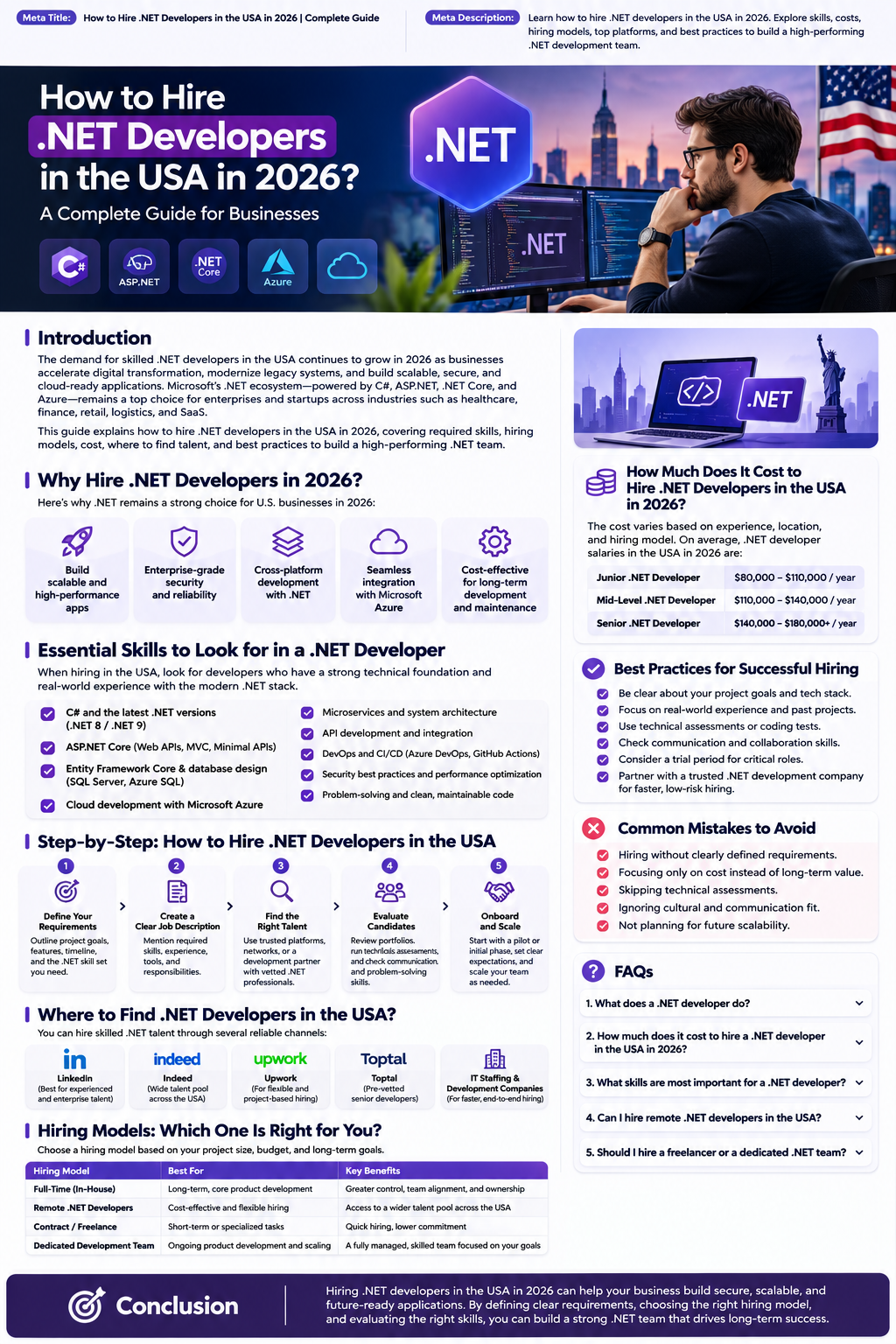
Finding the right .NET developer in the United States can be challenging in 2026. Businesses are increasingly looking for developers who can build scalable applications, modernize legacy systems, develop cloud-based solutions, integrate APIs, and work with modern technologies such as artificial intelligence.
Microsoft's .NET ecosystem remains a strong choice for enterprise applications, SaaS products, APIs, cloud platforms, internal business systems, and high-performance web applications.
However, hiring the right .NET developer requires more than searching for someone who knows C#. You need to evaluate technical skills, real-world experience, architecture knowledge, communication, problem-solving ability, and the developer's ability to work with your specific technology stack.
This guide explains how to hire .NET developers in the USA in 2026, including the skills to look for, expected hiring costs, where to find developers, hiring models, interview steps, and common mistakes to avoid.
Why Hire .NET Developers in 2026?
.NET remains an attractive technology for businesses that need secure, scalable, and maintainable software.
Companies can use .NET to build:
- Enterprise applications
- SaaS platforms
- E-commerce systems
- Financial applications
- Healthcare platforms
- CRM and ERP systems
- APIs and backend services
- Cloud applications
- Internal business software
- Mobile and web solutions
- AI-powered applications
A major advantage of the modern .NET ecosystem is its ability to support cross-platform development and cloud-native workloads.
Businesses can also combine .NET with Microsoft Azure, SQL Server, Entity Framework Core, APIs, microservices, DevOps tools, and modern AI services.
Key reasons businesses hire .NET developers include:
1. Scalable Application Development
Experienced .NET developers can build applications designed to handle growing numbers of users, transactions, and data.
2. Enterprise-Level Security
.NET provides a strong ecosystem for building secure business applications with authentication, authorization, data protection, and other security mechanisms.
3. Cross-Platform Development
Modern .NET supports development across different operating systems and environments.
4. Microsoft Azure Integration
.NET developers can build applications that integrate with Azure cloud services, databases, storage, authentication, monitoring, and deployment tools.
5. Long-Term Maintainability
A well-designed .NET application can be easier to maintain and expand as the business grows.
What Skills Should You Look for in a .NET Developer?
One of the most important steps when hiring .NET developers is creating a clear technical skills checklist.
Do not evaluate candidates based only on the number of years they have worked with .NET.
Instead, evaluate whether they have the skills needed for your actual project.
1. C# Programming
Strong knowledge of C# is essential for most .NET development roles.
Candidates should understand:
- Object-oriented programming
- Generics
- LINQ
- Async and await
- Exception handling
- Collections
- Dependency injection
- Clean coding practices
- Performance considerations
For senior positions, look for developers who can explain why they choose a particular implementation rather than simply writing code that works.
2. ASP.NET Core
ASP.NET Core is an important technology for modern .NET web development.
A good candidate should understand areas such as:
- Web APIs
- MVC
- Minimal APIs
- Middleware
- Authentication
- Authorization
- Dependency injection
- Routing
- Configuration
- Logging
- Performance optimization
For backend-heavy projects, ASP.NET Core experience should generally be one of the main hiring criteria.
3. Entity Framework Core
Developers working with data-driven applications should understand Entity Framework Core and database architecture.
Look for experience with:
- Entity Framework Core
- SQL Server
- Database design
- Relationships
- Migrations
- Query optimization
- Indexing
- Transactions
- Performance optimization
A developer who knows .NET but does not understand databases may struggle with large-scale applications.
4. API Development and Integration
Modern applications frequently communicate through APIs.
Your .NET developer should understand:
- REST APIs
- Authentication
- Authorization
- API versioning
- Error handling
- Data validation
- JSON
- Third-party API integration
- API documentation
API experience becomes particularly important when your application needs to communicate with payment systems, CRMs, ERPs, mobile applications, or external services.
5. Cloud Development
Cloud experience is increasingly valuable when hiring .NET developers.
Look for experience with:
- Microsoft Azure
- Azure App Service
- Azure Functions
- Azure SQL
- Azure Storage
- Azure DevOps
- Cloud monitoring
- Containers
- Deployment automation
A developer who understands both .NET and cloud infrastructure can often contribute beyond basic application development.
6. Microservices and System Architecture
For large or complex applications, you may need developers who understand software architecture.
Important skills include:
- Microservices
- Distributed systems
- Service communication
- Message queues
- Caching
- Scalability
- Load balancing
- Fault tolerance
- API gateways
These skills are particularly important when hiring senior .NET developers or technical leads.
7. DevOps and CI/CD
A modern development team should not only write code but also understand how software is tested, deployed, and maintained.
Look for familiarity with:
- Git
- GitHub
- Azure DevOps
- CI/CD pipelines
- Automated testing
- Docker
- Deployment automation
- Monitoring
DevOps knowledge can significantly reduce the friction between development and production.
8. Security
Security should be part of the developer's everyday workflow.
Candidates should understand:
- Authentication
- Authorization
- Secure APIs
- Data protection
- Input validation
- Secure database access
- Password security
- Common web vulnerabilities
- Secure coding practices
For applications handling financial, healthcare, customer, or enterprise data, security experience should be treated as a priority.
9. AI Integration
AI development is becoming increasingly relevant for modern software teams.
A .NET developer does not necessarily need to be an AI researcher, but experience integrating AI services can be valuable.
Look for experience with:
- AI APIs
- LLM integrations
- AI-powered search
- Document processing
- Chatbots
- Recommendation systems
- AI agents
- Data processing
This can help businesses add intelligent features to existing .NET applications.
How Much Does It Cost to Hire a .NET Developer in the USA?
The cost of hiring a .NET developer varies significantly based on experience, location, technical specialization, employment model, industry, and project complexity.
As a planning framework, businesses may encounter ranges such as:
| Experience Level | Illustrative Annual Salary |
|---|---|
| Junior .NET Developer | $80,000–$110,000 |
| Mid-Level .NET Developer | $110,000–$140,000 |
| Senior .NET Developer | $140,000–$180,000+ |
These are planning ranges rather than fixed market prices. Actual compensation can be significantly higher or lower depending on location, company, specialization, benefits, and demand.
For example, senior developers with strong Azure, architecture, cybersecurity, AI, or enterprise experience may command substantially higher compensation.
Location also matters. Hiring in major technology markets can be more expensive than hiring in lower-cost U.S. regions.
Salary Is Not the Only Hiring Cost
When calculating the real cost of hiring a .NET developer, consider more than base salary.
Additional costs may include:
- Health insurance
- Retirement benefits
- Paid leave
- Recruiting fees
- Equipment
- Software licenses
- Training
- Onboarding
- Management time
- Office costs
- Employer taxes
- Employee benefits
For this reason, businesses should compare the total cost of employment, not simply the advertised salary.
Where to Find .NET Developers in the USA
There are several platforms businesses can use to find qualified .NET developers.
LinkedIn is useful for finding experienced developers and enterprise-level talent.
It allows recruiters to search based on:
- Location
- Experience
- Skills
- Current company
- Previous experience
- Industry
It can be particularly useful when looking for senior or specialized .NET developers.
Indeed
Indeed provides access to a large U.S. developer talent pool and is useful for both active job seekers and broader recruitment.
Upwork
Upwork can be useful when you need:
- Freelancers
- Short-term developers
- Project-based specialists
- Flexible hiring
It may be a practical option for smaller projects or temporary development requirements.
Toptal
Toptal focuses on pre-vetted technology professionals and can be considered when a company wants access to experienced freelance or contract developers.
Specialized IT Staffing Companies
IT staffing and development companies can help businesses find developers more quickly, especially when internal recruitment resources are limited.
Step-by-Step: How to Hire .NET Developers in the USA
A structured hiring process can reduce the risk of hiring the wrong candidate.
Step 1: Define Your Requirements
Before posting a job, clearly define:
- Project goals
- Required features
- Technology stack
- Development timeline
- Experience level
- Budget
- Employment model
- Expected responsibilities
For example, saying:
"We need a .NET developer."
is too broad.
A better requirement might be:
"We need a senior .NET developer with C#, ASP.NET Core, Entity Framework Core, SQL Server, Azure, REST APIs, Docker, CI/CD, and experience building scalable SaaS applications."
This immediately improves the quality of candidates you attract.
Step 2: Create a Clear Job Description
Your job description should explain:
- Role
- Responsibilities
- Required technical skills
- Preferred skills
- Experience
- Project details
- Location
- Remote or hybrid expectations
- Compensation range
- Hiring process
Avoid adding dozens of unnecessary technologies simply to make the job description look impressive.
Focus on the skills the developer will actually use.
Step 3: Source Candidates
Use several channels rather than relying on one platform.
A combination of:
- Indeed
- Upwork
- Toptal
- Developer communities
- Referrals
- IT staffing firms
can help you reach different types of candidates.
Step 4: Screen Technical Experience
Review the candidate's:
- Previous projects
- GitHub profile
- Portfolio
- Technical responsibilities
- Architecture experience
- Database experience
- Cloud experience
- API development
- Testing practices
Do not judge candidates only by job titles.
A developer who has spent three years building complex enterprise systems may be more suitable than someone with five years of experience doing mostly basic maintenance work.
Step 5: Conduct a Technical Interview
A technical interview should test real-world problem solving rather than memorization.
Ask questions such as:
C#
"How would you improve the performance of a slow C# service?"
ASP.NET Core
"How would you design a secure REST API using ASP.NET Core?"
Database
"How would you investigate a slow SQL query?"
Architecture
"How would you design a .NET application expected to handle rapid user growth?"
Security
"What security risks would you consider when building a public API?"
Cloud
"How would you deploy and monitor a .NET application on Azure?"
The goal is to understand how the developer thinks.
Step 6: Use a Practical Coding Assessment
A short practical assignment can reveal more than a long interview.
For example, ask the candidate to:
- Build a small REST API.
- Connect an API to a database.
- Implement authentication.
- Create a small CRUD application.
- Optimize an existing piece of code.
- Identify security issues.
- Explain architectural decisions.
The assignment should be relevant to your actual project.
Avoid unnecessarily long unpaid assignments.
Step 7: Evaluate Communication Skills
Technical ability is important, but communication can determine whether a development project succeeds.
Evaluate whether the candidate can:
- Explain technical concepts clearly.
- Ask useful questions.
- Communicate project risks.
- Give realistic estimates.
- Explain trade-offs.
- Work with designers and product teams.
- Receive feedback.
- Document their work.
This is particularly important for remote development teams.
Step 8: Check References
For senior roles, consider checking professional references.
Ask about:
- Technical performance
- Reliability
- Communication
- Ownership
- Problem-solving
- Teamwork
- Ability to meet deadlines
References should complement—not replace—a strong technical evaluation.
Step 9: Start With a Structured Onboarding Process
Once you hire a developer, provide:
- Project documentation
- Repository access
- Development environment
- Coding standards
- Architecture documentation
- Communication channels
- Task management tools
- Development workflows
- Testing procedures
A structured onboarding process helps new developers become productive faster.
Which Hiring Model Should You Choose?
The right hiring model depends on the size and duration of your project.
Full-Time .NET Developer
Best for:
- Long-term products
- Core business applications
- Enterprise systems
- Continuous development
Advantages
- Strong ownership
- Better long-term alignment
- Deeper product knowledge
- Easier team collaboration
Remote .NET Developer
Remote hiring gives companies access to a wider talent pool.
It can be useful when:
- Local talent is limited.
- You need specialized skills.
- You want flexibility.
- You operate a distributed team.
However, communication, time zones, security, and project management need to be handled carefully.
Contract or Freelance Developer
A contractor can be useful for:
- Short-term projects
- Specific technical tasks
- MVP development
- Temporary capacity
- Specialized expertise
This model can reduce long-term employment commitments.
Dedicated Development Team
A dedicated development team can be useful when a company needs continuous product development without building an entire internal engineering department.
A team may include:
- .NET developers
- Frontend developers
- QA engineers
- DevOps engineers
- Project managers
- UI/UX designers
This can be particularly useful for startups and companies scaling digital products.
Common Mistakes When Hiring .NET Developers
1. Hiring Based Only on Price
The cheapest developer is not necessarily the most cost-effective.
Poor architecture, security problems, technical debt, and missed deadlines can cost significantly more later.
2. Hiring Without Clear Requirements
If you do not know what you need, it becomes difficult to identify the right candidate.
3. Focusing Only on Years of Experience
Ten years of experience does not automatically mean ten years of relevant experience.
Evaluate the complexity and quality of previous work.
4. Skipping Technical Assessments
A strong résumé does not guarantee strong technical ability.
5. Ignoring Communication
A technically excellent developer who cannot communicate project risks can create problems for the entire team.
6. Ignoring Scalability
The application may work today but fail when the number of users grows.
7. Hiring Without Security Awareness
Security should be considered from the beginning, especially for applications handling sensitive data.
How to Hire the Right .NET Developer for Your Project
Before making a final hiring decision, ask yourself:
- Does the candidate understand our technology stack?
- Have they built similar applications?
- Can they solve real technical problems?
- Do they understand databases?
- Do they understand APIs?
- Can they work with cloud infrastructure?
- Do they understand security?
- Can they communicate clearly?
- Can they work independently?
- Can they collaborate with our team?
- Can they grow with the project?
The strongest candidate is not necessarily the person with the longest résumé.
It is the person whose skills, experience, communication style, and working approach match your project.
.NET Developer Hiring Checklist
Use this checklist before making an offer:
Technical
- Strong C# knowledge
- ASP.NET Core experience
- Entity Framework Core
- SQL/database knowledge
- REST API development
- Authentication and authorization
- Cloud experience
- Git/version control
- Testing experience
- Security awareness
Professional
- Strong communication
- Problem-solving ability
- Relevant portfolio
- Good documentation habits
- Team collaboration
- Ability to work independently
- Realistic estimation skills
Hiring
- Requirements clearly defined
- Budget approved
- Technical assessment completed
- References checked where appropriate
- Employment model selected
- Onboarding plan prepared
Frequently Asked Questions
1. How much does it cost to hire a .NET developer in the USA?
The cost varies according to experience, location, specialization, employment model, and benefits. As a broad planning framework, businesses may see junior, mid-level, and senior compensation ranges around $80,000–$110,000, $110,000–$140,000, and $140,000–$180,000+ respectively, but actual market offers can differ substantially.
2. What skills should I look for when hiring a .NET developer?
Important skills include C#, ASP.NET Core, Entity Framework Core, SQL, REST APIs, authentication, cloud development, Git, testing, security, and problem-solving. Senior roles may also require architecture, microservices, DevOps, Azure, and AI integration experience.
3. Where can I find .NET developers in the USA?
Common hiring channels include LinkedIn, Indeed, Upwork, Toptal, developer communities, referrals, and specialized IT staffing companies.
4. Should I hire a freelance or full-time .NET developer?
Choose based on your project. Freelancers and contractors can be suitable for short-term or specialized work, while full-time developers are generally better for long-term products and core business systems.
5. How can I test a .NET developer before hiring?
Use a practical technical assessment based on your real project. Ask candidates to solve a relevant programming problem, build a small API, work with a database, explain architecture decisions, or identify security and performance issues.
Final Thoughts
Hiring .NET developers in the USA in 2026 requires more than finding someone who knows C#.
Businesses should evaluate the complete technical profile of a candidate, including ASP.NET Core, databases, APIs, cloud development, security, testing, architecture, DevOps, and problem-solving.
At the same time, communication, ownership, adaptability, and real-world project experience are just as important.
Whether you choose a full-time employee, remote developer, freelancer, contractor, or dedicated development team, the best hiring strategy begins with clearly defining your requirements.
Define the project. Identify the right skills. Test real-world ability. Evaluate communication. Then choose the hiring model that fits your business.
That approach can help you build a .NET development team capable of delivering secure, scalable, maintainable, and future-ready software.
About the author
- "Hire vetted senior .NET developers for your next project. ASP.NET Core | C# | Azure | Blazor | .NET MAUI Dedicated Developers • Staff Augmentation • Custom Software 🌐 dotnetdevelopers.us"
Comments
Join the discussionNo comments yet. Be the first to comment.